
Mutual Fund vs Fixed Deposit - Which Is Better in 2026?
When you have money to invest, one question often comes up: Should you put it in a Mutual Fund or a Fixed Deposit (FD)? Both are popular investment choices in India, but they serve very different purposes. A Fixed Deposit offers predictable returns and greater certainty, while Mutual Funds provide market-linked returns with the potential for higher long-term growth.
In 2026, choosing between the two is not simply about asking, “Which gives better returns?” Investors may also compare the mutual fund fixed deposit interest rate to understand how FD returns stack up against the potential returns from Mutual Funds. The right choice depends on your investment goal, time horizon, risk tolerance, liquidity needs, and tax situation. For example, an FD may make more sense when capital safety and a known maturity value are priorities, while a Mutual Fund may be more suitable for investors focused on long-term wealth creation and willing to accept market fluctuations.
So, Mutual Fund vs Fixed Deposit, which is better in 2026? In this guide, we compare both investment options across returns, risk, taxation, liquidity, short-term and long-term goals, and wealth-creation potential to help you understand which option may fit your financial objectives better.
What Is a Mutual Fund?
A mutual fund is an investment vehicle that pools money from many investors and invests it in a diversified portfolio of assets., equities, bonds, money market instruments or a combination of these, depending on the fund's stated objective. It is managed by a professional fund manager (or a team) working under an Asset Management Company (AMC), which is regulated by SEBI (Securities and Exchange Board of India).
When you invest in a mutual fund, you are allotted units whose value is reflected in the fund's Net Asset Value (NAV), which changes daily based on the performance of the underlying assets. You can invest either as a lump sum or through a Systematic Investment Plan (SIP), where a fixed amount is invested at regular intervals (usually monthly).
Broad categories include:
- Equity mutual funds - invest primarily in stocks; higher risk, higher long-term growth potential.
- Debt mutual funds - invest in bonds and fixed-income instruments; lower risk than equity, but not risk-free.
- Hybrid funds - a mix of equity and debt.
- Index funds/ETFs - passively track a market index like the Nifty 50 or Sensex.
What Is a Fixed Deposit?
A Fixed Deposit is a financial instrument offered by banks, small finance banks, post offices, and NBFCs, where you deposit a lump sum for a predetermined tenure - ranging from 7 days to 10 years - in exchange for a fixed rate of interest. The interest rate is locked in at the time of booking and does not change with market movements, regardless of what happens to interest rates or the economy afterward.
At maturity, you receive your principal plus the accumulated interest. Some FDs offer periodic interest payouts (monthly, quarterly or annually), while cumulative FDs compound the interest and pay it all out at maturity. Bank FDs up to ₹5 lakh (principal plus interest combined) are insured by the DICGC, which adds a layer of safety that mutual funds do not have.
Mutual Fund vs Fixed Deposit: Key Differences
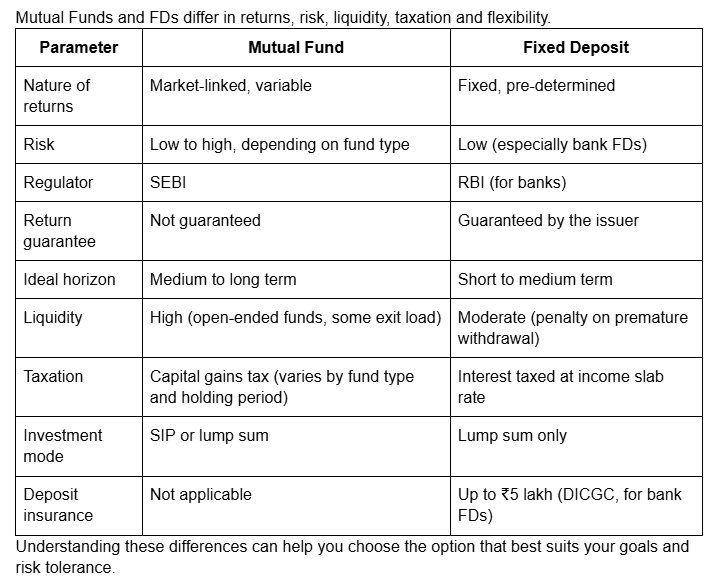
Mutual Fund vs FD - Returns and Growth Potential
This is where the two instruments diverge the most. FD returns in 2026 from major banks broadly range in the mid-single digits, with most large banks offering roughly 6%-7.5% per annum on regular tenures, and small finance banks or NBFCs offering somewhat higher rates - sometimes touching 8%-8.5% - for select tenures. Senior citizens typically get an additional 0.25%-0.75% on top of these rates. These returns are fixed for the entire tenure, regardless of what happens in the economy. Mutual funds, especially equity funds, do not offer a fixed rate - but historically, well-managed equity mutual funds and index funds in India have delivered inflation-beating, double-digit annualised returns over long periods (typically 7-10+ years), though this varies significantly by market cycle and is never guaranteed. Debt mutual funds tend to deliver returns closer to FDs, sometimes marginally higher or lower depending on interest rate movements, but with more volatility than a fixed deposit.
The key trade-off, FDs offer certainty of return, while mutual funds offer the potential for higher returns at the cost of predictability.
Mutual Fund vs FD - Which Is Better for Short-Term Goals?
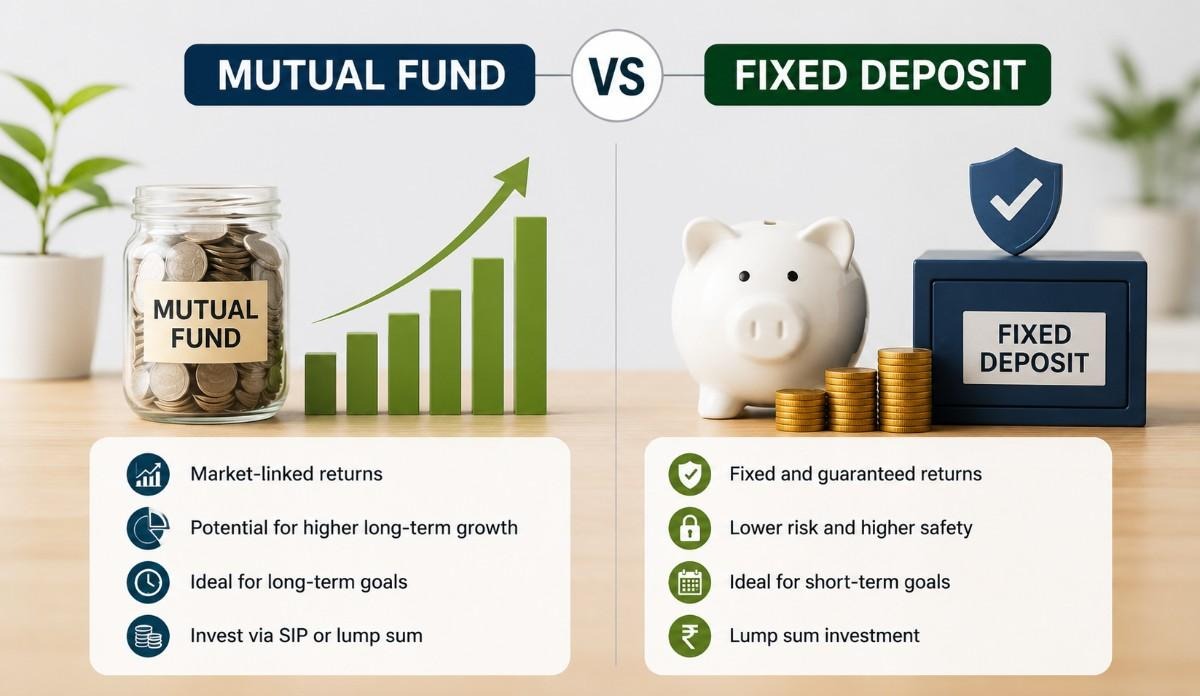
For goals within 1-3 years - such as a wedding fund, a planned purchase, or an emergency buffer - capital protection and predictability usually matter more than growth potential. FDs (or short-duration/liquid debt mutual funds, which behave similarly to FDs but with slightly more flexibility and potentially better post-tax returns for very short durations) are generally the more suitable category for such goals, since market volatility could work against you if you need the money on a fixed date. Equity mutual funds are generally not considered appropriate for short-term goals, given the possibility of a market downturn right when you need to withdraw.
Mutual Fund vs FD - Which Is Better for Long-Term Goals?
For goals more than 5-7 years away - retirement, a child's education or long-term wealth building - equity mutual funds have historically had more room to ride out market volatility and benefit from the power of compounding, since short-term dips tend to smooth out over longer holding periods (though this is a historical pattern, not a guarantee). FDs, by contrast, offer a fixed rate for a fixed tenure and reinvestment at maturity depends on whatever the prevailing rate is at that time - which can work for or against you depending on the interest rate cycle. For long-term goals, many investors use mutual funds (often via SIPs) as the primary growth engine, with FDs playing a smaller, stabilising role.
Which Is Better for Wealth Creation in 2026?
If the primary objective is long-term wealth creation rather than capital preservation, equity mutual funds - through SIPs that harness rupee-cost averaging and compounding - have historically had greater potential to outpace inflation and grow wealth over long horizons compared to FDs. FD returns, while safe, have often struggled to meaningfully beat inflation once taxed at slab rate, particularly for investors in higher income brackets. That said, "better for wealth creation" comes with higher volatility, and this approach is only suitable for money that isn't needed in the near term and for investors who can stay invested through market cycles.
How to Choose Between a Mutual Fund and Fixed Deposit
A few practical questions can help guide the decision:
- What is the money for, and when will you need it? Short-term, fixed-date goals lean toward FDs; long-term goals lean toward mutual funds.
- How would you react to a temporary loss in value? If market fluctuations would cause significant stress or force you to withdraw at the wrong time, FDs or debt funds may suit you better.
- What tax bracket are you in? Higher-bracket taxpayers may find equity mutual funds more tax-efficient for long-term holdings compared to FD interest taxed at slab rate.
- Do you need guaranteed capital protection? If yes, FDs (within DICGC limits) offer more certainty than any mutual fund category.
- Are you investing a lump sum or building wealth gradually? SIPs in mutual funds suit gradual, disciplined investing; FDs suit lump-sum deployment for a known period.
It's worth remembering that this is general information, not personalised financial advice - your specific tax situation, goals and risk appetite matter and consulting a qualified financial advisor in Vadodara can help you apply these principles to your own circumstances.
Pro Tip: Planning to invest in mutual funds? A mutual fund advisor in Vadodara can help you assess fund options according to your risk level and investment horizon.
Conclusion
Choosing between a Mutual Fund and a Fixed Deposit is not about finding one investment that is better for everyone. The right choice depends on your financial goals, investment horizon, need for stability, and comfort with market fluctuations. FDs can provide predictable returns and stability for short-term needs, while Mutual Funds can offer greater long-term growth potential. For many investors, using both can be a practical approach, keeping suitable funds in FDs for stability and short-term requirements while investing in Mutual Funds for long-term wealth creation.
At MTrust Investments, investors can get guidance to understand different investment options and build an investment approach aligned with their financial goals and risk profile. Before investing, evaluate your objectives carefully and consider seeking professional financial guidance to make informed decisions.
Frequently Asked Questions
1. Is a Mutual Fund better than a Fixed Deposit in 2026?
Neither option is universally better. Mutual Funds may offer higher long-term growth potential but come with market risk, while FDs provide fixed and predictable returns. The right choice depends on your financial goals, investment horizon and risk tolerance.
2. Which is safer: Mutual Fund or Fixed Deposit?
Fixed Deposits are generally considered safer because they offer predetermined returns and bank FDs are covered by DICGC insurance up to ₹5 lakh per depositor per bank. Mutual Funds are market-linked and do not offer guaranteed returns.
3. Which gives higher returns: Mutual Funds or Fixed Deposits?
Mutual Funds, particularly equity funds, have historically offered greater long-term return potential than FDs. However, returns are not guaranteed and can fluctuate with market conditions. FDs provide lower but predictable returns.
4. Should I choose a Mutual Fund or FD for long-term investment?
For long-term goals such as retirement or wealth creation, equity-oriented Mutual Funds may be more suitable because they offer greater growth potential and benefit from compounding. FDs may be preferred when capital safety and predictable returns are more important.
5. Can I invest in both Mutual Funds and Fixed Deposits?
Yes. You do not necessarily have to choose only one. Many investors use FDs for short-term needs, capital stability or emergency savings and Mutual Funds for long-term wealth creation. The appropriate combination depends on your goals, financial situation and risk tolerance.